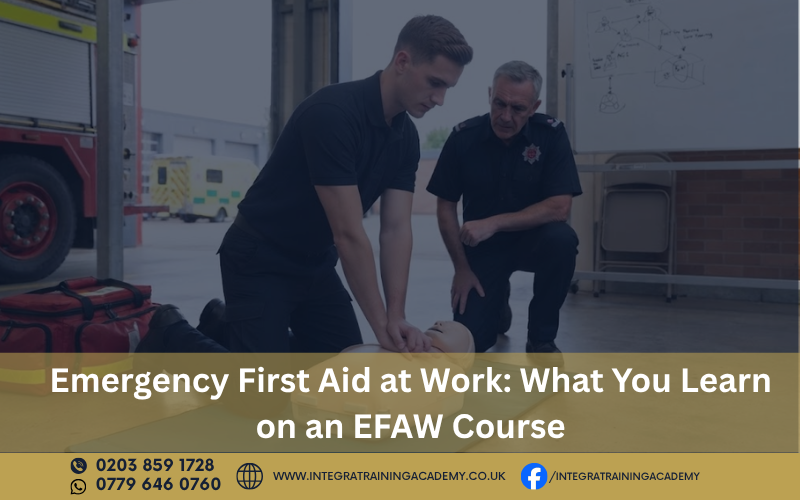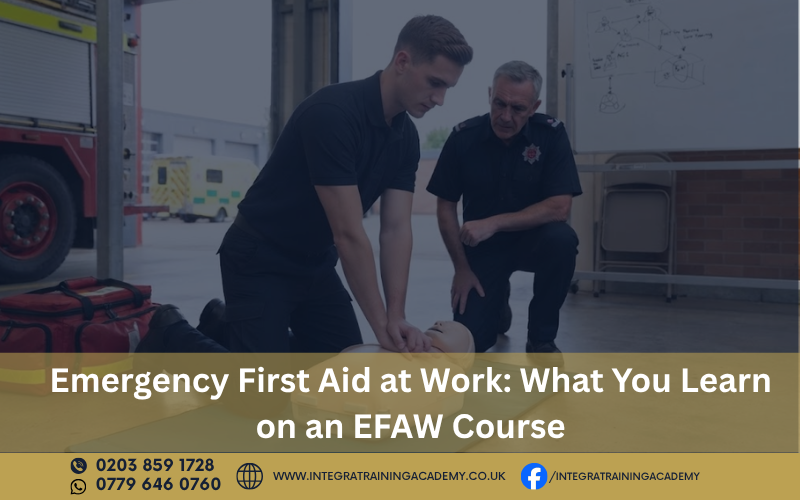
An Emergency First Aid at Work (EFAW) course teaches practical skills for responding to someone who becomes ill or injured at work. It focuses on immediate first aid, helping a casualty safely until further medical assistance is available.
For people considering workplace first aid training, one of the main questions is what they will actually learn during the course. EFAW training covers the role of the first aider, scene safety, CPR, automated external defibrillator (AED) use, unconscious casualties, choking, bleeding, shock and minor injuries.
The course is designed around emergency situations rather than providing the broader range of knowledge covered by the longer First Aid at Work (FAW) qualification.
What Is an EFAW Course?
Emergency First Aid at Work is a workplace first-aid training course designed to prepare a person to provide immediate assistance when someone is injured or becomes ill at work.
The Health and Safety Executive (HSE) explains that EFAW training enables a first-aider to provide emergency first aid, while the more comprehensive FAW course covers EFAW content plus additional specific injuries and illnesses.
An EFAW course is therefore focused on the first response. Learners develop practical skills that can be used while emergency services are being contacted or until more advanced medical care becomes available.
For learners looking for workplace first aid training, the Emergency First Aid at Work Training Wembley can provide a practical route into this type of training.
How Long Does EFAW Training Take?
The standard EFAW course is commonly delivered as a one-day course. HSE guidance refers to the one-day EFAW syllabus, while the recognised course content is based around a minimum of six hours of training, excluding breaks.
The training includes both knowledge and practical activities. This matters because first aid is a practical skill: understanding what should happen is different from being able to perform an appropriate response.
Depending on the training arrangement and qualification, learners may complete practical exercises and an assessment demonstrating their competence.
What Do You Learn on an EFAW Course?
The exact delivery can vary between training providers and qualification specifications, but the core EFAW syllabus covers several important areas.
1. The Role of the First Aider
Before dealing with an emergency, learners need to understand the responsibilities and limitations of a first aider.
This includes understanding:
-
How to assess an emergency situation
-
How to act safely and promptly
-
The importance of personal safety
-
How to reduce the risk of cross-infection
-
The importance of recording incidents and actions
-
How to use available first-aid equipment appropriately
-
When additional medical assistance is required
The first aider's role is not to replace an ambulance crew, doctor or other healthcare professional. Their responsibility is to provide appropriate immediate assistance within their level of training.
2. Assessing an Emergency Situation
A first aider needs to make sensible decisions before approaching a casualty.
EFAW training covers how to assess the situation and circumstances so that assistance can be provided safely and effectively.
This means considering potential hazards rather than immediately putting yourself at risk. For example, a workplace incident could involve machinery, traffic, electricity, fire, chemicals or other hazards.
The basic principle is straightforward: a first aider should not become another casualty.
3. CPR and Resuscitation
Cardiopulmonary resuscitation (CPR) is one of the key practical skills taught on an EFAW course.
Learners are taught how to respond when a casualty is unconscious and not breathing normally, including how to perform CPR appropriately.
Practical training gives learners an opportunity to practise the correct technique rather than simply reading about it.
Because resuscitation guidance can be updated, first aid training should reflect current accepted first-aid practice and the relevant training syllabus.
4. Using an Automated External Defibrillator
An automated external defibrillator, commonly called an AED, is another important part of EFAW training.
Learners are taught how an AED can be used alongside CPR when dealing with a cardiac arrest.
The training generally includes practical familiarisation with the equipment, including how to follow the device's prompts and apply the pads correctly.
An AED is designed to guide the user through the process, but practical training helps learners become more familiar with what to expect during an emergency.
5. Dealing With an Unconscious Casualty
An unconscious person requires immediate assessment and appropriate first aid.
EFAW training covers how to respond to an unconscious casualty, including situations involving seizures.
Learners develop an understanding of how to assess the casualty, maintain safety and provide appropriate first aid while arranging further assistance.
The course also introduces situations where a casualty may be breathing normally but remains unconscious, requiring appropriate positioning and ongoing observation.
6. Responding to Choking
Choking can become life-threatening if the airway is blocked and the casualty cannot breathe effectively.
EFAW training teaches learners how to recognise choking and respond appropriately.
The practical element is particularly useful because a first aider may need to distinguish between a casualty who can still cough or speak and someone experiencing a severe airway obstruction.
Knowing what action to take, and when to escalate the response, is an important part of emergency first aid.
7. Managing Wounds and Bleeding
Cuts and other wounds are common workplace injuries, but significant bleeding can become a serious emergency.
EFAW learners are taught how to provide first aid to a casualty who is wounded and bleeding.
Training covers the principles of controlling bleeding and responding safely while arranging further medical assistance where necessary.
Learners may also cover appropriate treatment for minor injuries as part of the course.
8. Recognising and Responding to Shock
Shock can occur following serious injury or illness and requires appropriate first-aid management.
EFAW training teaches learners how to recognise signs associated with shock and provide suitable first aid while seeking further assistance.
Understanding shock is important because the seriousness of an injury is not always immediately obvious. A casualty may require urgent medical attention even when the external injury appears limited.
9. Treating Minor Injuries
EFAW training also covers appropriate first aid for minor injuries.
The HSE syllabus identifies examples including:
-
Small cuts
-
Grazes
-
Bruises
-
Minor burns and scalds
-
Small splinters
These situations may not require an ambulance, but knowing how to provide sensible first aid can help prevent a minor injury from becoming worse.
Is EFAW Mostly Practical or Theory?
EFAW training combines knowledge with practical learning.
This is an important distinction because first aid is not simply a subject to memorise. A learner needs to understand what to do and demonstrate that they can apply relevant techniques.
HSE guidance states that training organisations should assess learners as competent before issuing the relevant certificate.
Practical activities may involve CPR practice, AED familiarisation, casualty assessment and scenarios involving common workplace emergencies.
The exact assessment method depends on the qualification and training provider, so learners should check the course specification before booking.
What Is the Difference Between EFAW and FAW?
EFAW and First Aid at Work (FAW) are not the same qualification.
EFAW focuses on emergency first aid and provides the core skills needed to respond to immediate workplace emergencies. FAW includes the EFAW content but goes further, covering a wider range of specific injuries and illnesses.
|
EFAW |
FAW |
|
Emergency-focused first aid |
More comprehensive workplace first aid |
|
Usually one day |
Typically a longer course |
|
Covers CPR and AED use |
Includes EFAW content plus additional topics |
|
Covers unconscious casualties, choking, bleeding and shock |
Covers a broader range of injuries and illnesses |
|
Appropriate where identified by the workplace first-aid needs assessment |
Used where a more comprehensive first-aider qualification is required |
The appropriate level should be determined by the employer's first-aid needs assessment rather than simply choosing the shorter course.
Who Might Take an EFAW Course?
EFAW training can be relevant to people who have been nominated to provide workplace first aid where the employer's assessment identifies this level of training as appropriate.
It can also be useful for individuals who want practical emergency first-aid skills for their workplace responsibilities.
Workplaces can have very different risks. An office, retail environment, construction site and industrial workplace may require different first-aid arrangements.
The HSE recommends that employers assess first-aid needs based on factors such as the nature of the work, workforce, workplace hazards, working patterns and access to emergency services.
Does an EFAW Certificate Last Forever?
No. An EFAW certificate is generally valid for three years when issued in accordance with the relevant workplace first-aid training requirements. HSE guidance states that certificates should indicate a three-year validity period.
However, maintaining first-aid skills is not simply about waiting until the certificate expires.
The HSE strongly recommends that first aiders undertake annual refresher training to help maintain their basic skills.
Employers should also consider whether their workplace first-aid arrangements remain appropriate as their risks, workforce, premises or working patterns change.
What Should You Expect During an EFAW Training Day?
Although course delivery varies, learners can generally expect a mixture of explanation, demonstration, practice and assessment.
A typical learning experience may include:
-
Introduction to the first aider's role
-
Safety and emergency scene assessment
-
Demonstration of first-aid techniques
-
Practical CPR and AED exercises
-
Unconscious casualty and seizure scenarios
-
Choking response
-
Bleeding and shock management
-
Minor injury first aid
-
Practical assessment
-
Feedback and completion of the course
The practical exercises are particularly valuable because they allow learners to practise techniques in a controlled training environment before they may need to use them during a real emergency.
How Does Workplace First Aid Fit Into an Employer's Responsibilities?
EFAW training is only one part of workplace first-aid provision.
Employers should carry out a first-aid needs assessment to determine what equipment, facilities and trained personnel are appropriate for their particular workplace. HSE guidance says provision should be adequate and appropriate to the circumstances, including the hazards and risks of the workplace.
This means an employer should not automatically assume that one EFAW-trained person is sufficient for every workplace.
Factors can include:
-
The type of work being performed
-
Workplace hazards
-
Number of employees
-
Working patterns and shifts
-
Absence or holidays
-
The location and size of the workplace
-
Access to emergency services
-
Presence of members of the public
-
Previous incidents and relevant risks
The training level should follow the needs assessment.
Common Mistakes When Choosing EFAW Training
People booking workplace first aid training sometimes focus only on the course price or duration. That can overlook important questions about the actual training and assessment.
Before booking, consider:
Check the Course Content
Make sure the course covers the appropriate EFAW syllabus and practical skills required for the qualification.
Check the Training Provider
HSE guidance advises employers to carry out appropriate due diligence when selecting a first-aid training provider, including checking competence, trainers, course content and quality assurance arrangements.
Check the Assessment
Find out how learners will demonstrate competence and whether practical skills are assessed.
Consider Workplace Risk
Do not select EFAW simply because it is shorter than FAW. The appropriate level of training depends on the workplace's first-aid needs.
Think About Refresher Training
Maintaining practical skills between qualification periods can help first aiders remain confident and prepared.
Is an EFAW Course Right for You?
If you are unsure whether an Emergency First Aid at Work course matches your needs, consider your reason for taking the training.
Someone nominated as a workplace first aider may need EFAW because it has been identified as the appropriate level through their employer's first-aid needs assessment. Another person may simply want to develop practical emergency response skills.
The important question is not just, "Is EFAW shorter?" It is, "Does this level of training match the risks and responsibilities involved?"
For readers comparing their options, Is an EFAW Course Right for You? can help explore the situations in which this type of training may be appropriate.