Workplace emergencies can happen without warning. An employee may suffer a fall, a serious cut, a burn, become unconscious or experience a sudden medical emergency. In these situations, knowing how to respond appropriately before professional medical help arrives can be extremely important.
Emergency First Aid at Work (EFAW) training gives suitable workplace personnel an introduction to practical emergency first aid skills. Depending on the course, learners may develop knowledge relating to CPR, AED use, unconscious casualties, severe bleeding, shock and common workplace injuries.
For employees researching efaw training in wembley, it is important to look beyond location and compare the course content, practical elements, trainer experience and certification information before booking. Employers should also consider their wider first aid arrangements rather than assuming one particular course is appropriate for every workplace.
What Is Emergency First Aid at Work Training?
Emergency First Aid at Work, commonly abbreviated to EFAW, is workplace first aid training designed to help a first aider respond to an emergency involving someone who becomes ill or is injured at work.
The Health and Safety Executive (HSE) explains that EFAW training enables a first aider to provide emergency first aid to someone who is injured or becomes ill while at work. First Aid at Work (FAW) training covers the EFAW content while also providing training for a wider range of specific injuries and illnesses.
EFAW can therefore be viewed as one level of workplace first aid training rather than a universal solution for every workplace.
EFAW Is Different From General First Aid Awareness
General first aid awareness may introduce employees to emergency procedures and basic principles, but formal EFAW training is intended for people undertaking a recognised workplace first aid course.
The exact course content should always be checked with the training provider. Employers should also consider the risks and circumstances identified through their first aid needs assessment.
Who Can Undertake EFAW Training?
EFAW can be relevant to employees or other appropriate personnel selected to support workplace first aid arrangements. The suitability of the training depends on the workplace and its identified needs.
An employer may consider factors such as:
-
The nature of the work
-
Workplace hazards
-
Number and distribution of employees
-
Working patterns
-
Shift arrangements
-
Location and accessibility
-
Presence of visitors or members of the public
-
Lone-working arrangements
-
Distance from emergency medical services
The purpose is not simply to have someone with a certificate. The training should form part of an appropriate first aid arrangement.
Why Workplace First Aid Knowledge Matters
A workplace can contain a wide range of hazards. Even relatively low-risk environments can experience accidents or sudden illness.
Examples include:
-
Slips, trips and falls
-
Cuts and minor wounds
-
Burns
-
Sprains
-
Serious bleeding
-
Loss of consciousness
-
Breathing difficulties
-
Cardiac emergencies
-
Sudden illness
-
Injuries involving equipment or machinery
A trained first aider may be able to provide appropriate immediate assistance while emergency services are being contacted or while professional medical help is on its way.
This does not mean a workplace first aider replaces paramedics, doctors or other healthcare professionals. First aid training provides people with skills and knowledge appropriate to their level of training so that they can respond within the limits of their competence.
The HSE advises employers to assess their first aid requirements and ensure that appropriate first aid personnel, facilities and equipment are available for workplace circumstances.
How EFAW Training Can Support Emergency Response
The value of EFAW training is largely practical. Rather than simply reading about first aid, learners can be introduced to the principles and procedures involved in responding to workplace emergencies.
Depending on the specific course, learners may develop knowledge and practical skills relating to:
Assessing an Emergency
Before providing assistance, a first aider needs to recognise that an emergency has occurred and understand the importance of personal safety.
Training can introduce learners to structured approaches for assessing an incident and deciding what assistance is required.
Checking Responsiveness
Recognising whether a casualty is responsive is an important part of an emergency response.
Training can help learners understand how to respond appropriately when someone is unconscious or unresponsive and when emergency medical assistance should be sought.
Calling for Emergency Assistance
First aid is not carried out in isolation.
Effective workplace emergency procedures should make it clear how employees can summon assistance, contact emergency services and direct responders to the correct location.
CPR
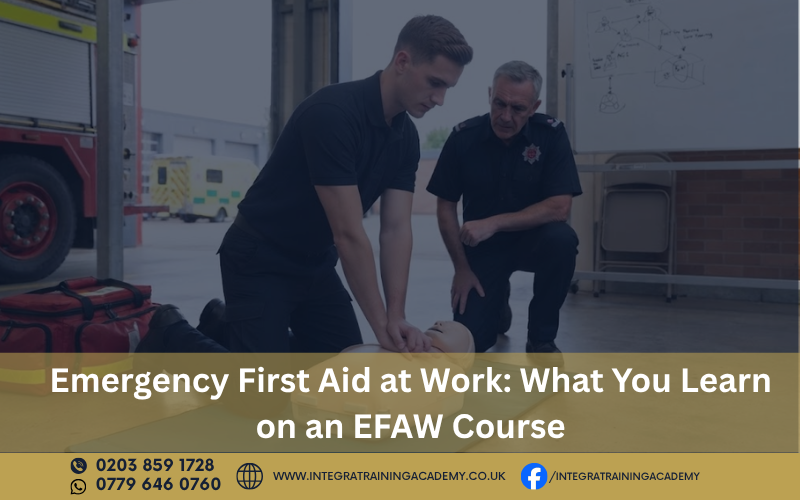
Cardiopulmonary resuscitation, commonly known as CPR, is an important emergency response skill covered by many workplace first aid courses.
EFAW learners should receive instruction according to the syllabus of their particular course rather than relying on a general article as a substitute for practical training.
AED Awareness and Use
An automated external defibrillator (AED) can form part of workplace emergency preparedness where one is available and appropriate.
Training may introduce learners to the role of an AED and how it is used during a cardiac emergency. The exact treatment of AED use should be confirmed with the training provider.
Severe Bleeding and Shock
Serious bleeding requires an appropriate emergency response, while shock can occur in connection with serious injury or illness.
Training can help learners recognise situations requiring urgent assistance and understand the appropriate response within the limits of their training.
EFAW Training Can Help Employees Respond With Greater Confidence
In an emergency, people may have to act quickly while also communicating with colleagues and emergency services.
Practical training can help employees understand the sequence of actions expected of them instead of having to rely entirely on guesswork.
For example, an employee who has completed workplace first aid training may have a clearer understanding of:
-
How to recognise an emergency
-
How to summon help
-
How to follow workplace emergency procedures
-
When professional medical assistance is required
-
How to use available first aid equipment
-
The importance of staying within their training
Hands-on exercises can be particularly useful because first aid involves practical skills rather than theoretical knowledge alone.
First aid knowledge also needs to be maintained. HSE strongly recommends annual refresher training during the three-year FAW/EFAW certification period, although annual refresher training itself is not mandatory. HSE guidance also states that first aid certificates are valid for three years and employers should arrange retraining before certificates expire.
What Skills Can EFAW Training Cover?
Course content varies, so learners should check the syllabus supplied by their chosen provider. However, workplace EFAW training commonly addresses emergency situations and practical first aid skills relevant to workplace incidents.
CPR and AED
CPR is an important emergency response skill for situations involving a person who is unresponsive and not breathing normally.
Where AED training is included, learners can also become familiar with the role of an automated external defibrillator in an emergency.
The purpose of training is to develop practical competence rather than simply provide theoretical information.
Unconscious Casualty
An unconscious or unresponsive casualty requires prompt attention and appropriate emergency procedures.
EFAW training can help learners understand how to assess the situation, summon emergency assistance and respond according to their training.
Severe Bleeding
Severe bleeding can represent a serious medical emergency.
Workplace first aid training can help learners understand the importance of recognising significant bleeding and obtaining emergency medical assistance promptly.
The appropriate response depends on the circumstances, the training received and the available equipment.
Shock
Shock is a serious condition that can occur following significant injury or illness.
First aid training can introduce learners to the general signs and appropriate emergency response while emphasising the need for professional medical assistance where required.
Common Workplace Injuries
Workplace first aid training may also cover more common injuries such as:
-
Cuts
-
Burns
-
Minor wounds
-
Falls
-
Sprains
-
Other workplace-related injuries
The objective is to help learners understand appropriate first aid responses rather than encourage them to diagnose medical conditions themselves.
Who Can Benefit From EFAW Training?
EFAW training can be relevant across many workplace environments, although the appropriate level of first aid provision depends on the employer's assessment of workplace needs.
Potential environments include:
-
Offices
-
Retail businesses
-
Warehouses
-
Construction-related workplaces
-
Hospitality businesses
-
Facilities management
-
Security operations
-
Manufacturing
-
Education
-
Commercial premises
-
Mixed-use workplaces
For example, a warehouse may have different hazards from an office, while a construction environment may present different risks from a retail store.
This is why employers should not assume that EFAW is automatically the correct choice simply because it is a commonly available workplace first aid course.
The HSE's guidance states that the findings of an employer's first-aid needs assessment should help determine whether FAW, EFAW or another appropriate level of training is required.
EFAW and Employer First Aid Arrangements
Workplace first aid training is only one part of a broader first aid arrangement.
Employers should consider the circumstances of their workplace when determining what first aid provision is appropriate. The HSE identifies factors such as the nature of work, workforce distribution, workplace risks and the distance from emergency services as relevant considerations.
Other factors may include:
-
Number of employees
-
Working hours
-
Shift patterns
-
Lone workers
-
Remote workers
-
Workplace layout
-
Multiple buildings or work areas
-
Presence of visitors
-
First aid equipment
-
First aid facilities
-
Availability of trained first aid personnel
-
Emergency contact arrangements
-
Access for emergency responders
A suitable first aid needs assessment can help employers identify gaps and decide what arrangements are appropriate.
First aid kits and other equipment should also be considered as part of the overall system. Training personnel without suitable equipment or clear emergency procedures may leave an organisation with an incomplete approach to workplace emergency preparedness.
What to Know Before Taking EFAW Training
Before booking an EFAW course, learners should understand what the course actually includes, how practical participation is assessed and whether it is appropriate for their intended workplace role. A useful Know Before Taking EFAW Training resource can help learners compare course information and understand what they should check before making a booking.
Consider the following:
-
Course content
-
Practical training requirements
-
Course duration
-
Assessment arrangements
-
Training provider experience
-
Certification information
-
Refresher arrangements
-
Learner suitability
-
Practical participation
-
Workplace relevance
-
Course location
-
Booking requirements
Employers should also tell the training provider about relevant workplace hazards where appropriate. HSE guidance notes that employers should inform the training organisation about particular workplace hazards so training can be tailored where additional training is needed.
How to Choose an EFAW Training Provider
Choosing a training provider involves more than comparing course prices.
Employers and learners should look for clear information about the course, including its syllabus, practical elements, assessment arrangements and certification.
Useful questions include:
Does the course provide practical learning?
First aid is practical by nature. Learners should understand what hands-on activities are included and whether practical assessment forms part of the course.
Are trainers appropriately experienced?
Training providers should be able to explain the competence and experience of their trainers.
HSE guidance recommends that employers carry out appropriate due diligence when selecting a first aid training provider, including checking trainer competence, relevant course content and quality assurance arrangements.
Is course information clear?
A professional provider should clearly explain:
-
What the course covers
-
Who it is designed for
-
How long it takes
-
Assessment arrangements
-
Certification information
-
Booking process
-
Course location
-
Any learner requirements
Does the training suit the workplace?
The most appropriate course is not necessarily the shortest or cheapest option. The decision should relate to the employer's first aid needs assessment and workplace circumstances.
EFAW Training for Security Professionals
Security professionals can work in environments where incidents involving injuries, illness or medical emergencies may occur.
This can include:
-
Door supervisors
-
Security guards
-
Event security personnel
-
Retail security officers
-
Site security personnel
-
Front-of-house security teams
-
Crowd-facing security personnel
A security professional may be among the people present when an incident occurs, particularly at busy events, retail premises, construction sites or commercial facilities.
EFAW training can therefore provide useful emergency first aid knowledge for security personnel, depending on their role and employer's requirements.
However, EFAW should not be confused with security-specific training. Completing EFAW does not by itself qualify someone to work as a security professional. Security roles can have separate training and licensing requirements.
For someone considering both areas of professional development, Door supervisor training in wembley may be relevant as a separate security-training pathway, while EFAW addresses workplace emergency first aid skills.
EFAW vs FAW: What Is the Difference?
EFAW and FAW are both workplace first aid qualifications, but they have different scopes.
|
Area |
EFAW |
FAW |
|
Course purpose |
Emergency workplace first aid |
More comprehensive workplace first aid |
|
Scope |
Basic emergency first aid |
Wider range of injuries and illnesses |
|
Typical workplace use |
Depends on workplace needs |
Depends on workplace needs |
|
Training content |
Course-specific and defined by the relevant course |
Broader course scope |
|
Employer suitability |
Depends on first aid needs assessment |
Depends on first aid needs assessment |
|
Appropriate for every workplace? |
No |
No |
HSE guidance explains that FAW includes the content covered by EFAW while extending to a range of specific injuries and illnesses. The appropriate level should be determined by the workplace's first aid needs.
There is therefore no universal rule that EFAW should always be chosen over FAW, or vice versa.
Why Practical First Aid Training Matters
Reading first aid information is useful, but practical training provides a different learning experience.
During practical training, learners may have opportunities to:
-
Practise CPR techniques
-
Become familiar with an AED
-
Work through emergency scenarios
-
Practise communication during an incident
-
Understand workplace emergency procedures
-
Learn how to respond within the limits of their training
Practical exercises can also help learners understand how first aid procedures work in realistic workplace situations.
The HSE notes that basic first aid guidance is not a substitute for effective training, reinforcing the importance of appropriate formal instruction where workplace first aid training is required.
EFAW Training in Wembley
For people looking for EFAW training in Wembley, practical considerations can include the training centre's accessibility, course dates, practical facilities and the information provided before booking.
Learners may wish to check:
-
Whether the course dates fit their availability
-
Where the training takes place
-
What practical activities are included
-
Who delivers the training
-
What certification information is provided
-
Whether the course is appropriate for their intended workplace role
-
What booking and payment arrangements apply
Local accessibility can make training easier to attend, particularly for employees, security professionals and employers arranging training for several members of staff.
The location, however, should be considered alongside course suitability and quality rather than being the only factor in choosing a provider.
How EFAW Training Fits Into Workplace Safety
First aid training works best as part of a wider workplace safety system.
It can complement:
-
Workplace risk assessments
-
First aid needs assessments
-
Emergency action plans
-
Fire safety procedures
-
First aid kits
-
AED availability
-
Emergency contact procedures
-
Incident reporting
-
Employee safety training
-
Workplace health and safety procedures
The HSE emphasises the importance of assessing workplace first aid needs and making suitable arrangements based on the circumstances of the work.
For example, a workplace may have trained first aiders but still need to improve the visibility of first aid equipment, emergency contact information or procedures for summoning professional assistance.
A well-planned system considers the complete emergency response rather than treating the training certificate as the end goal.