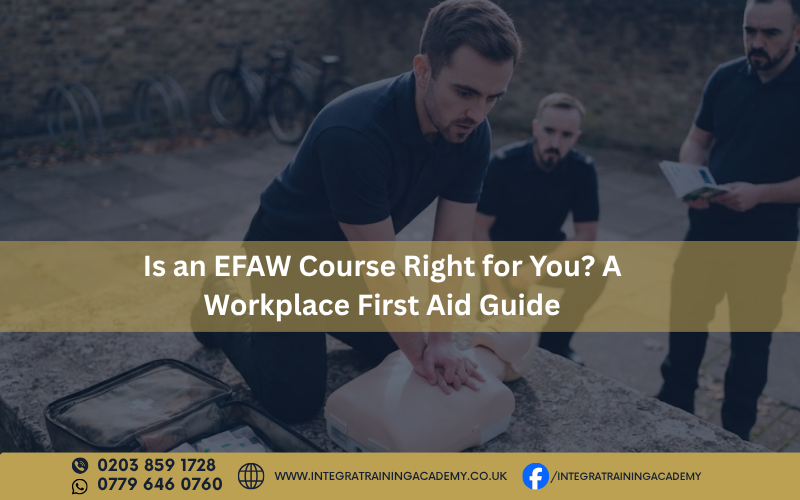
An Emergency First Aid at Work (EFAW) course can help you develop the practical skills and confidence needed to respond when someone becomes seriously ill or injured at work. From office environments and retail premises to construction sites and security operations, knowing how to act during a medical emergency can make a significant difference while professional medical assistance is on its way.
However, EFAW training is not the right option for everyone. The most suitable course depends on your workplace responsibilities, the risks you may encounter, your employer’s first-aid arrangements and, in some cases, the requirements of your chosen career.
This guide explains what an EFAW course involves, who may benefit from it, how it compares with First Aid at Work (FAW) training, and what to consider before enrolling. It also covers the responsibilities UK employers have when deciding what level of workplace first-aid provision is appropriate.
What Is an Emergency First Aid at Work Course?
An Emergency First Aid at Work course is practical first-aid training designed to prepare learners to respond to workplace injuries and sudden illnesses. It focuses on recognising an emergency, taking appropriate initial action and supporting an affected person until further medical help arrives.
The Health and Safety Executive (HSE) identifies EFAW as one of the recognised levels of workplace first-aid training. It is generally a more focused option than the full First Aid at Work qualification, which covers a wider range of injuries and illnesses.
Depending on the course syllabus, learners may practise essential skills such as:
-
Assessing an emergency and checking whether the scene is safe.
-
Recognising when someone needs urgent medical attention.
-
Responding to an unresponsive casualty who is not breathing normally.
-
Performing cardiopulmonary resuscitation (CPR).
-
Understanding how an automated external defibrillator (AED) is used.
-
Managing bleeding and providing appropriate initial care for injuries.
-
Summoning emergency services and communicating essential information.
The exact syllabus and assessment requirements depend on the training programme. Before booking, check that the course covers the skills relevant to your workplace and any specific qualification requirements you need to meet.
An EFAW certificate demonstrates completion of the relevant training and assessment. It does not make someone a medical professional or qualify them to deal with every possible medical emergency.
Who Should Consider Taking an EFAW Course?
EFAW training may be suitable for people who want practical first-aid skills for their job, career development or workplace responsibilities.
1. Employees with workplace first-aid responsibilities
Some employees are selected to act as workplace first aiders following an employer’s first-aid needs assessment. If this responsibility has been assigned to you, EFAW may be suitable where the assessment identifies that this level of training is appropriate.
Your employer should consider the nature of the work, workplace hazards, number of employees, working patterns and the availability of first-aid cover before deciding which training is needed.
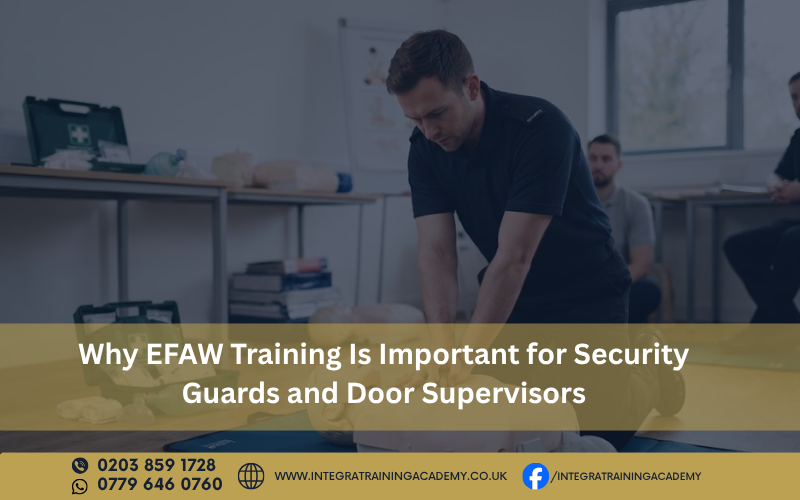
2. Security guards and door supervisors
Security professionals may encounter incidents involving injuries, sudden illness or members of the public who require urgent assistance.
First-aid knowledge can be useful in settings such as shopping centres, offices, construction sites, licensed premises and public events. Security personnel may be among the first people to notice that someone needs help, particularly when working away from a dedicated medical team.
For people pursuing a career in security, first-aid training can also have a specific qualification-related purpose. The Security Industry Authority (SIA) requires relevant first-aid qualifications before learners undertake licence-linked door supervision or security guarding training. The exact requirements should be checked against the current SIA guidance and the course being taken.
If you are looking for practical training in North West London, Efaw Training in wembley can be a relevant starting point for exploring your training options through Integra Training Academy.
3. Staff working in offices, shops and customer-facing environments
Employees in offices, retail stores, reception areas and other customer-facing workplaces may benefit from knowing how to respond to an unexpected medical incident.
For example, a colleague might collapse, a visitor might sustain an injury, or someone might become unwell while waiting for assistance. A trained first aider can take appropriate initial action, call for professional help and support the casualty within the limits of their training.
Whether EFAW is sufficient depends on the risks and first-aid needs of the specific workplace.
4. People working in higher-risk environments
Construction, warehousing, manufacturing and other environments involving machinery, manual handling or potentially hazardous materials may present additional first-aid challenges.
Workers in these settings may benefit from first-aid knowledge, but an EFAW course is not automatically sufficient for every higher-risk workplace. Employers should assess the likely injuries and illnesses and determine whether full FAW training or additional specialist training is needed.
5. Individuals who want practical emergency skills
You do not have to be employed as a designated first aider to see the value in learning how to respond to an emergency.
EFAW training may suit people who want to develop practical skills, improve their confidence when helping others or prepare for work in environments where first-aid awareness is valuable. However, if your employer requires a specific qualification, confirm that the course meets that requirement before enrolling.
EFAW vs FAW: Which Workplace First-Aid Course Should You Choose?
EFAW and First Aid at Work (FAW) training serve related purposes, but they differ in the breadth of first-aid knowledge they cover. Choosing between them should be based on the workplace's actual needs rather than course length or price alone.
|
Consideration |
Emergency First Aid at Work (EFAW) |
First Aid at Work (FAW) |
|
Main purpose |
Initial response to workplace injuries and sudden illness |
Emergency response plus a broader range of injuries and illnesses |
|
Training scope |
Focused emergency first aid |
More comprehensive workplace first aid |
|
Suitable setting |
Workplaces where the needs assessment identifies EFAW as appropriate |
Workplaces where a wider range of first-aid skills is required |
|
Typical learner |
Employee or designated first aider needing emergency-level training |
Employee or designated first aider needing broader training |
|
Certificate validity |
Generally three years for the relevant qualification |
Generally three years for the relevant qualification |
The distinction in training scope is reflected in HSE guidance. FAW includes EFAW-level learning but extends to a wider range of injuries and illnesses.
When is EFAW likely to be sufficient?
EFAW may be suitable when an employer's first-aid needs assessment identifies that emergency-level training meets the risks of the workplace.
For example, a relatively low-risk workplace may need a different level of provision from a busy warehouse where staff work around heavy equipment. Even within the same industry, the layout, working hours, number of employees and availability of first aiders can change what is appropriate.
When should you consider FAW instead?
Full FAW training may be more appropriate when employees face a wider range of foreseeable injuries or illnesses, or when the workplace assessment identifies a need for more comprehensive first-aid skills.
If you are an employee booking training independently, ask your employer which qualification is required. If you are choosing a course for a business, assess your workplace needs before deciding.
What Will You Learn on an EFAW Course?
An EFAW course focuses on recognising emergencies and providing appropriate initial care. The precise content depends on the course and the requirements it is intended to meet.
Common learning areas include:
-
Emergency assessment: checking for immediate danger and assessing the casualty.
-
Unresponsive casualties: recognising when someone is unresponsive and assessing whether they are breathing normally.
-
CPR and AED awareness: understanding how to respond to cardiac arrest and use a defibrillator.
-
Bleeding and injuries: providing appropriate initial care, including recognising potentially life-threatening bleeding.
-
Communication: calling 999 when necessary, giving clear information and following emergency-service instructions.
-
Casualty care: offering reassurance and monitoring the person's condition while waiting for further help.
Learners should expect practical activities and assessment appropriate to the qualification. For example, CPR skills are not simply a matter of memorising instructions; they need to be practised and assessed.
Security professionals should pay particular attention to the requirements for licence-linked training. Current SIA guidance specifies additional content relating to life-threatening bleeding and opening airways, alongside the standard EFAW syllabus. A general workplace course should not automatically be assumed to satisfy every security-industry requirement.
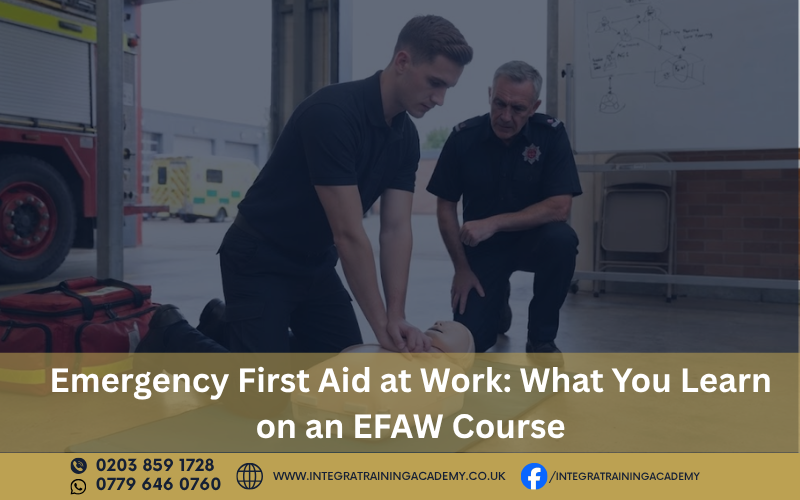
For a more detailed breakdown of the learning outcomes, the guide Emergency First Aid at Work What You Learn on an EFAW Course can help you understand the practical skills covered and what to expect from training.
Do UK Employers Require Employees to Hold an EFAW Certificate?
Not every employee is legally required to hold an EFAW certificate. UK workplace first-aid arrangements depend on the employer's responsibilities and the findings of a first-aid needs assessment.
Under the Health and Safety (First-Aid) Regulations 1981, employers must make adequate and appropriate first-aid arrangements for their employees. This includes considering the workplace, workforce and potential hazards. Depending on the assessment, an employer may need trained first aiders or may be able to meet its needs through an appointed person and suitable arrangements.
What is a first-aid needs assessment?
A first-aid needs assessment helps an employer decide what equipment, facilities, training and personnel are required.
Relevant considerations include:
-
The type of work carried out and the hazards involved.
-
The size and distribution of the workforce.
-
Shift patterns, remote working and lone workers.
-
The availability of trained first aiders during absences.
-
The workplace's distance from emergency medical services.
-
Whether members of the public or visitors may also need assistance.
There is no single fixed number of first aiders that is suitable for every workplace. Employers must consider their individual circumstances and provide appropriate cover.
What is the difference between an appointed person and a first aider?
An appointed person takes charge of first-aid arrangements, such as maintaining equipment and contacting emergency services. This role does not, by itself, require formal first-aid training.
A trained first aider has completed suitable training and holds the relevant qualification. If an assessment identifies the need for trained first aiders, an appointed person alone will not replace that requirement.
This distinction matters for small businesses. An employer should not assume that appointing someone to look after the first-aid kit automatically satisfies every workplace first-aid need.
Is EFAW Training Useful for Your Career?
First-aid skills can be valuable across a range of occupations. They can help employees respond more confidently to emergencies and may be relevant when a role involves responsibility for the safety of colleagues, customers or members of the public.
For aspiring security guards and door supervisors, the qualification may also be an essential step before starting the relevant SIA licence-linked training. However, you should verify the exact qualification, syllabus and certificate validity required for your intended course.
For other occupations, EFAW can support workplace readiness, but it is not a substitute for a job-specific qualification or specialist first-aid training where those are needed.
It is also worth distinguishing general first-aid training from paediatric first aid, mental health first aid and specialist emergency-response courses. These address different needs and should be considered where the workplace assessment or job responsibilities call for them.
How Long Does an EFAW Certificate Last?
An EFAW certificate for workplace first-aid purposes generally lasts three years. Before it expires, the first aider should complete the appropriate requalification training to maintain their qualification.
The HSE also strongly recommends annual refresher training to help first aiders keep their skills up to date. Refresher training is not the same as a formal requalification course.
If you need the qualification for employment or security-industry training, check the specific validity requirements before booking. The SIA has additional rules for first-aid qualifications used before licence-linked training, including a requirement that an accepted qualification has at least 12 months of validity remaining when that training starts.
How to Choose the Right EFAW Training Provider
Selecting a suitable training provider is just as important as deciding which course to take. Employers are responsible for ensuring that the training they choose is delivered by a competent provider.
Before enrolling, consider the following:
-
Course suitability: Confirm that the course meets your employer's needs or the requirements of your intended occupation.
-
Practical assessment: Ask how CPR, casualty assessment and other practical skills are taught and assessed.
-
Certificate requirements: Check what qualification is awarded and whether it is accepted for your intended purpose.
-
Course arrangements: Confirm the training date, location, duration and any preparation required.
-
Additional requirements: If you are pursuing security training, verify that the course covers the relevant SIA requirements.
The HSE no longer approves general workplace first-aid training providers. Instead, employers must make appropriate checks to establish that the provider they select is competent. You should therefore avoid assuming that a course is suitable solely because its advertising uses the term “HSE approved”.
Integra Training Academy provides a route for learners to explore EFAW training options in Wembley, UK. If you are considering enrolling, check the current course details and confirm that the training meets your requirements before making a booking.