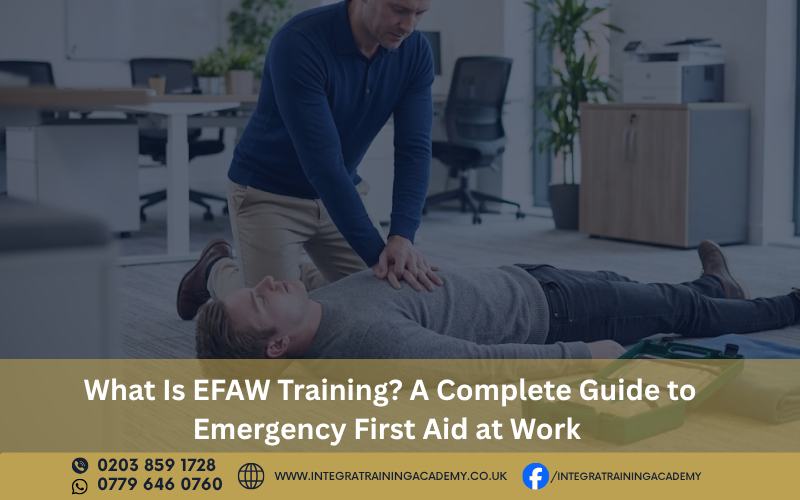
EFAW Training means Emergency First Aid at Work training. It is designed to help people respond appropriately when someone becomes ill or is injured in the workplace. An EFAW Training Course focuses on essential emergency first-aid skills, including casualty assessment, CPR, AED use, managing severe bleeding and responding to an unconscious casualty.
For people researching Emergency First Aid at Work EFAW Training Courses, understanding what the training involves is important before choosing a course. Whether you are an employee, employer, manager or workplace first aider, EFAW can form part of an organisation's wider workplace first-aid arrangements.
If you are looking for EFAW training in Wembley, the same principles apply: the appropriate level of training should reflect the needs and risks of the workplace. The Health and Safety Executive (HSE) advises employers to carry out a first-aid needs assessment and ensure that first-aid provision is adequate and appropriate for their circumstances.
What Is EFAW Training?
EFAW training is workplace first-aid training that prepares a learner to provide emergency first aid to someone who becomes ill or is injured at work.
EFAW stands for Emergency First Aid at Work. It is one of the training options that employers can consider when arranging workplace first-aid provision.
The purpose is not simply to teach general first-aid theory. Learners develop practical knowledge and skills that can help them respond to an emergency, provide appropriate initial assistance and summon further professional help when necessary.
HSE guidance explains that EFAW training enables a first aider to provide emergency first aid to someone injured or taken ill at work. It distinguishes EFAW from First Aid at Work (FAW), which covers a broader range of specific injuries and illnesses.
The appropriate training level depends on the employer's first-aid needs assessment, rather than a one-size-fits-all approach.
What Does EFAW Stand For?
EFAW = Emergency First Aid at Work.
Each part of the name describes the purpose of the training:
-
Emergency – focuses on responding to urgent situations where immediate assistance may be required.
-
First Aid – covers initial care provided to someone who is injured or becomes ill.
-
At Work – places those skills within a workplace environment.
This makes EFAW particularly relevant to organisations that need trained personnel as part of their workplace first-aid arrangements.
What Is Covered in an EFAW Training Course?
The exact course content can vary according to the training specification and provider, but EFAW training typically covers essential emergency first-aid knowledge and practical skills.
Common topics include:
|
Topic |
What Learners Typically Learn |
|
Casualty assessment |
How to assess an incident and casualty safely and identify what action may be required. |
|
CPR |
How to perform cardiopulmonary resuscitation as part of an emergency response. |
|
AED |
How an automated external defibrillator may be used during a cardiac emergency. |
|
Recovery position |
How to position an unconscious but breathing casualty appropriately while awaiting further help. |
|
Severe bleeding |
How to provide appropriate initial assistance for serious bleeding. |
|
Choking |
How to respond appropriately when a person is choking. |
|
Burns |
Appropriate immediate first-aid measures for burns. |
|
Shock |
Recognising possible signs of shock and providing appropriate initial care. |
Training may also address other common workplace emergencies and the importance of maintaining the first aider's own safety.
HSE guidance for training providers sets out an EFAW syllabus and states that training should reflect current accepted first-aid practice.
For anyone considering an EFAW training course, it is sensible to check the provider's current syllabus rather than assuming every course is delivered in exactly the same way.
Who Is EFAW Training For?
EFAW training may be suitable for people who could have a first-aid role within a workplace, depending on the employer's needs assessment.
Potential learners include:
-
Employees
-
Workplace first aiders
-
Office staff
-
Retail employees
-
Security personnel
-
Hospitality workers
-
Construction workers
-
Warehouse employees
-
Supervisors and managers
-
Small business teams
-
Employees working in environments where emergency first-aid provision is required
For example, a security professional may encounter a medical emergency while working at a commercial premises, while a retail employee could need to respond to an injury involving a customer or colleague.
However, EFAW should not automatically be assumed to be the correct option for every workplace. Employers should consider hazards, risks, working arrangements and other relevant circumstances when determining their first-aid provision.
Why Is EFAW Training Important in the Workplace?
A workplace emergency can develop quickly. Someone may collapse, suffer a serious cut, experience breathing difficulties or become unconscious before professional medical assistance arrives.
Appropriate first-aid training can help a trained person respond more confidently and systematically.
EFAW training can support workplace safety by helping learners understand:
-
How to recognise an emergency
-
How to assess a casualty
-
When emergency services may be required
-
How to provide appropriate initial assistance
-
How to use emergency first-aid equipment
-
How to communicate relevant information
-
How to protect themselves while assisting someone else
The objective is not to replace professional medical care. Instead, workplace first aid provides immediate assistance while further help is being arranged.
HSE guidance states that workplace first-aid provision should enable immediate assistance to casualties and the summoning of an ambulance or other professional help when required.
What Skills Do You Learn During EFAW Training?
EFAW involves practical first-aid skills as well as supporting knowledge. Depending on the course, learners may practise how to:
-
Recognise an emergency situation
-
Carry out an initial casualty assessment
-
Perform CPR
-
Use an AED appropriately
-
Place an unconscious breathing casualty in the recovery position
-
Respond to severe bleeding
-
Deal with choking
-
Provide appropriate initial care for burns
-
Recognise potential shock
-
Communicate effectively with emergency services
-
Consider personal safety when providing first aid
These skills are important because knowing what to do in theory is different from being able to respond appropriately during an emergency.
Practical first aid training gives learners the opportunity to develop familiarity with procedures and equipment under instructor guidance.
Is EFAW Training Practical or Theory-Based?
EFAW training is not simply classroom theory.
A good workplace first-aid course should give learners opportunities to understand and practise relevant emergency procedures. This may include instructor demonstrations followed by learner practice.
Depending on the provider and current course specification, practical learning can include:
-
CPR practice
-
AED familiarisation
-
Casualty assessment exercises
-
Recovery-position practice
-
First-aid scenarios
-
Instructor-led demonstrations
-
Practical assessment where applicable
HSE guidance also advises employers to consider whether a training provider's course content meets the needs identified through the workplace first-aid needs assessment.
If you are comparing providers, look beyond the course title and review what practical learning is actually included.
How Does EFAW Training Support Workplace Safety?
First aid is one part of a wider workplace health and safety system.
Effective workplace first-aid arrangements can include appropriate:
-
Trained first aiders
-
First-aid equipment
-
First-aid kits
-
Workplace procedures
-
Emergency contact arrangements
-
Communication systems
-
Information for employees
-
Arrangements for summoning emergency services
Employers should assess their own workplace circumstances and make suitable arrangements. HSE guidance describes first-aid provision as needing to be adequate and appropriate in the circumstances, taking account of workplace hazards, risks and working arrangements.
Training alone does not create a complete first-aid system. Equipment, procedures, trained personnel and clear arrangements all have a role.
EFAW Training vs First Aid at Work: What's the Difference?
EFAW and First Aid at Work (FAW) are different levels of workplace first-aid training.
|
Area |
EFAW |
First Aid at Work |
|
Training scope |
Focuses on emergency first-aid response. |
Covers emergency first aid plus a broader range of injuries and illnesses. |
|
Intended purpose |
Enables a trained person to provide emergency first aid at work. |
Provides broader first-aid knowledge and skills for workplace first-aid duties. |
|
Typical workplace need |
May be appropriate where a needs assessment identifies this level of provision. |
May be appropriate where workplace hazards and circumstances require broader first-aid provision. |
|
Level of first-aid training |
Focused emergency response training. |
More comprehensive workplace first-aid training. |
|
Course content |
Includes core emergency response skills such as CPR, AED and casualty care. |
Includes EFAW-level emergency care plus additional injury and illness topics. |
HSE specifically explains that EFAW enables emergency first aid to be provided to someone injured or taken ill at work, while FAW includes EFAW and extends to a range of specific injuries and illnesses.
The correct option should be determined according to the workplace's first-aid needs rather than simply choosing the shorter or broader course.
How Do Employers Decide What First Aid Training Is Needed?
Employers should carry out a first-aid needs assessment appropriate to the circumstances of each workplace.
Factors that may need consideration include:
-
Workplace hazards
-
The nature of work activities
-
Number of employees
-
Working patterns and shifts
-
Workplace layout
-
Employees working alone
-
Multiple work locations
-
Previous workplace incidents
-
Higher-risk activities
-
Distance from emergency medical services
-
The number of people who may need assistance
For example, the needs of a small office may be very different from those of a construction site, warehouse or large retail environment.
HSE guidance recommends assessing first-aid needs for each workplace and considering factors such as hazards, risks and alternative working patterns.
Employers in Wembley and elsewhere should therefore use current HSE guidance when reviewing their workplace first-aid arrangements.
EFAW Training in Wembley: What Should You Look For?
If you are searching for EFAW training in Wembley, compare courses based on more than location or price.
Consider the following:
-
Course content: Does it cover the emergency first-aid skills relevant to your needs?
-
Practical training: Does the course provide opportunities to practise important skills?
-
Trainer information: Is relevant instructor and assessor information available?
-
Training facilities: Are appropriate facilities and equipment provided?
-
Assessment: Is the assessment approach clearly explained?
-
Certification: Does the provider clearly explain what evidence of successful completion is issued?
-
Suitability: Is the course appropriate for your intended workplace role?
-
Course dates: Are the available dates suitable for you or your organisation?
-
Provider information: Is clear information available about the organisation and its training?
-
Accessibility: Is the training location convenient from Wembley and surrounding areas?
HSE provides guidance for employers on selecting first-aid training providers, including considerations around trainer competence, quality assurance, syllabus content and certificates.
How to Choose an EFAW Training Course
Before booking an EFAW course, use this checklist:
-
Check what the course covers.
-
Confirm that it is suitable for your intended workplace role.
-
Review the provider's course information.
-
Check available trainer or instructor information.
-
Understand how practical learning and assessment are handled.
-
Check what certificate or evidence of completion is provided.
-
Confirm course dates and availability.
-
Ask the provider questions if your workplace requirements are unclear.
-
If you are an employer, compare the course with the findings of your first-aid needs assessment.
If you are ready to explore structured EFAW training course information, review the course content and provider information before deciding whether it matches your requirements.
What Happens After Completing EFAW Training?
After successfully completing an EFAW programme, learners receive evidence of completion according to the training provider's arrangements.
For employers, a suitably trained person may form part of the organisation's workplace first-aid arrangements where that level of training meets the needs assessment.
However, training should not be viewed as a one-off solution to workplace first aid. Employers should review their arrangements when circumstances change and ensure that first-aid personnel remain appropriately trained and competent.
HSE guidance states that employers who provide workplace first aiders should ensure they have suitable training, an appropriate first-aid qualification and remain competent to perform their role.
HSE's guidance for training providers also sets out requirements concerning certificates for EFAW and FAW training, including confirmation of the certificate's validity period.